
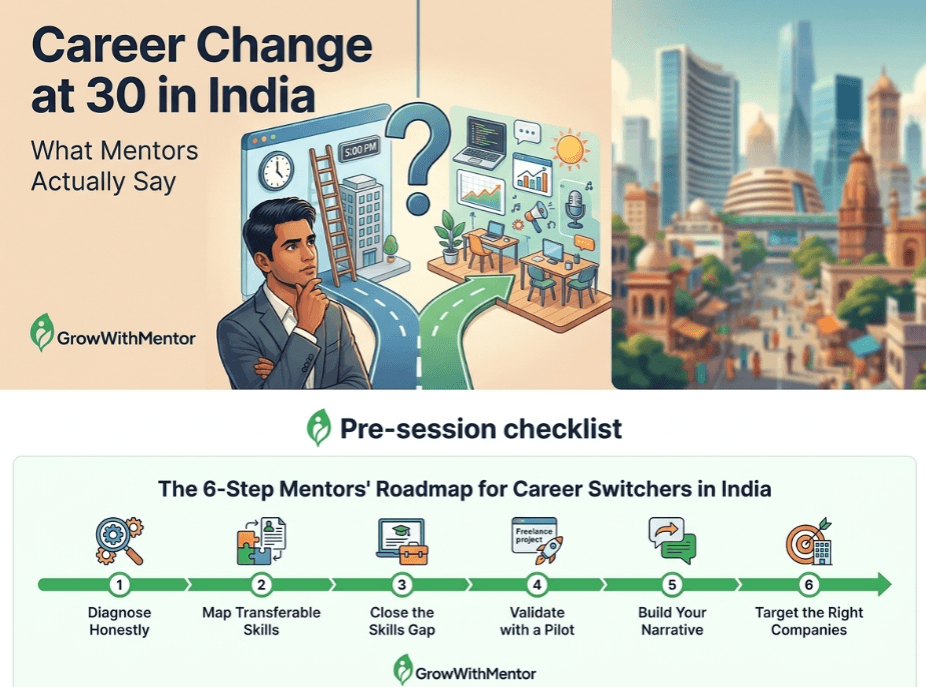
You’ve been in the same role for years. The salary is fine. The job is stable. And you’re quietly miserable. If you’re considering a career switch at 30 in India, this is the honest, no-filter guide you’ve been searching for.
Thirty hits differently in India.
In most countries, your 30s are when you finally start figuring things out. In India, 30 feels like a deadline. By now you’re supposed to have a stable job, a clear career track, a flat in the works, and ideally a spouse. Changing careers at this point? That’s the kind of thing people do in movies — not real life.
Except it is real life. Every week, thousands of Indian professionals in their 30s are quietly searching “career change at 30 India” — engineers wondering whether product management is possible, bankers drawn to digital marketing, teachers wanting to get into edtech, and mid-level IT professionals who’ve been at the same keyboard for eight years wondering if there’s more.
So we asked the people who know best: experienced mentors across India — professionals in IT, digital marketing, finance, business, and career coaching — what they actually tell clients who come to them considering a career switch at 30. This is what they said.
📊 India career reality check
By 2030, India’s job market will look fundamentally different — an estimated 12 million new jobs created, 9 million automated away, and over 47 million workers needing to reskill. Waiting until “the right time” to switch is itself a career risk.
The real fear behind “is it too late?”
When an Indian professional at 30 asks whether it’s too late to change careers, they’re rarely asking about age. They’re asking about five specific fears that are deeply tied to how career and identity work in Indian culture.
Fear 1 — Family judgment. In India, a career change at 30 isn’t a private decision. Parents, in-laws, extended family, and neighbours all have opinions. “Log kya sochenge?” is a real force in career decision-making — and mentors see it daily.
Fear 2 — Financial reset. Starting over means potentially taking a salary cut. At 30, with EMIs, rent, and household expenses, a 30–40% drop in income for 12–18 months feels terrifying.
Fear 3 — Starting from zero. “I’ll be competing with 22-year-olds who are hungrier and cheaper.” This is one of the most common things mentors hear — and one of the most inaccurate.
Fear 4 — Lost years. “I’ve spent 7 years building expertise in this domain. Switching means throwing all of it away.” The reality, as mentors point out, is almost always the opposite.
Fear 5 — The unknown. You know the problems in your current role. The new field has problems you can’t see yet — and that uncertainty is its own kind of paralysis.
Every mentor interviewed for this piece said the same thing: these fears are legitimate, but they’re being used as reasons to stay rather than signals to plan. Fear is useful information. It’s telling you what to prepare for — not whether to go.
“The professionals who successfully switch careers at 30 are not the ones who aren’t afraid. They’re the ones who treated the fear as a checklist — addressed each item, then moved.”
— Senior career mentor, GrowWithMentor (11 years in Project management)
5 myths Indian professionals believe about switching at 30
Before we get to the roadmap, let’s dismantle the beliefs that keep most people stuck. Mentors across the GrowWithMentor platform consistently identify these five myths as the biggest obstacles to a successful career switch in India.
Myth
“You’ll have to start from scratch like a fresher”
Your 8 years of professional experience — stakeholder management, deadline pressure, workplace communication, industry knowledge — travels with you. You’re not starting over. You’re redirecting. Most switchers reach their previous salary level within 18–24 months in the new field.
Myth
“A career switch at 30 needs an MBA”
Myth
An MBA can accelerate a pivot — but it’s not the only path, especially with India’s booming ecosystem of online certifications, portfolio-based roles, and startup hiring. A ₹50,000 online certification plus 3 months of freelance projects often does more than a 2-year ₹25L MBA for functional role changes.
“Employers won’t hire a career switcher at 30”
Startups and new-economy companies actively prefer career switchers — they bring domain knowledge from a different industry, maturity, and real-world context that fresh graduates simply don’t have. Age bias exists in some legacy companies and government sectors, but it is rapidly shrinking in tech, marketing, and business roles.
Myth
“It’s too risky financially with EMIs and family”
This is only true if you quit your job on day one. Every mentor interviewed said the same thing: don’t resign before you have a plan. Most successful career switchers test their new field for 3–6 months through freelance projects, part-time courses, or internal pivots — before a single day of lost income.
Myth
“Your family will never understand — so don’t try”
Indian families respond to evidence, not arguments. Showing up with a concrete plan — “here’s what I’m doing, here’s the income trajectory, here’s a 12-month roadmap” — lands very differently than “I’m unhappy and want to change.” Most families come around when they see seriousness and structure.
Unsure if a career switch is right for you?
Book a free 1-on-1 session with a GrowWithMentor career mentor — get an honest, India-specific assessment of your situation in 30 minutes.
What mentors in India actually advise — field by field
Career advice is only useful when it’s specific. Here’s what mentors on the GrowWithMentor platform say to professionals in the most common switch scenarios — the conversations that happen in real 1-on-1 mentorship sessions.
If you’re an IT/software professional wanting to switch
This is the most common scenario in India today — engineers who are technically strong but feel disconnected from the work. Mentors say the best moves from here are usually within-tech but different in function rather than out of tech entirely:
- Software engineer → Product manager: Your technical fluency is your edge. PMs who understand how code actually works are in short supply. Most mentors recommend the PM path for engineers who like solving user problems more than writing code.
- Backend developer → Data analyst/scientist: SQL and Python are shared skills. The pivot is shorter than most engineers assume — 6 months of focused learning and a portfolio project.
- IT support/operations → Cloud/DevOps: AWS, Azure, and GCP certifications are now a clear monetisable path. Mentors call this the single highest-ROI career switch available in Indian tech right now.
What mentors actually say: “Don’t leave tech unless you have a compelling pull toward something else — not just a push away from your current role. If you love tech but hate your company, change companies first.”
If you’re in a non-tech role wanting to enter tech
The good news: India’s tech sector is large enough and diverse enough that almost every background has a route in. Mentors recommend starting with tech-adjacent roles first — business analyst, project coordinator, customer success at a tech company — rather than trying to become a software engineer from scratch at 30.
🇮🇳 India-specific insight
Tier 2 city professionals often face an additional barrier: the assumption that good opportunities only exist in Bangalore, Hyderabad, or Mumbai. Mentors consistently point out that remote work has permanently changed this — a career switch combined with remote work is now a legitimate and increasingly common path for professionals in Pune, Jaipur, Indore, Coimbatore, and Kochi.
Real story: From banking operations to digital marketing at 31
🌟 GrowWithMentor — Mentee success story
Arjun K., Pune → Digital Marketing Lead
7 years in banking operations · Switched at 31 · Now earning 45% more
Arjun had spent seven years at a private bank in Pune in back-office operations. The role was stable, the package was decent, and he hadn’t once felt excited about a Monday morning.
He came to GrowWithMentor with one question: “I’m 31. Is it genuinely too late for me to get into digital marketing, or am I kidding myself?” His mentor — a senior performance marketing professional — told him something he hadn’t expected to hear: “Your finance background is actually an advantage. You understand budgets, ROI, and data — most digital marketers don’t.”
Over six 1-on-1 sessions across three months, his mentor helped him build a learning plan, identify his transferable skills, create a portfolio of mock campaigns, and target fintech and BFSI companies specifically — where his banking background was a differentiator, not a liability.
Arjun did not quit his job. He spent evenings completing a Google Ads and Meta certification, ran pro-bono campaigns for two small businesses, and documented the results. Four months later, he had his first digital marketing interview. Eight months after his first mentor session, he joined a Pune-based fintech startup as a performance marketing executive — with a 30% salary increase from day one.
🎯 Outcome: Career switch completed in 8 months, without a single day of unemployment, with a 30% salary increase and a 45% increase 18 months later.
Your story could start the same way
Find a mentor who’s already in the field you’re targeting. One honest conversation can cut months of guesswork.
The 6-step roadmap mentors give career switchers in India
This is the framework that comes up, with small variations, in almost every career switch conversation on GrowWithMentor. It assumes you’re employed, have financial obligations, and cannot afford to quit without a plan. That’s most Indian professionals at 30 — and the roadmap is built for exactly that reality.
Diagnose honestly — is it the field or the company
The most expensive mistake in career switching is misdiagnosing the problem. If you hate your company’s culture, toxic manager, or lack of growth — that’s a company problem, not a career problem. Fix it by changing employers before you change careers. If you’ve tried that and the dissatisfaction runs deeper — that’s when a career switch makes sense.🇮🇳 India note: Spend at least one conversation with a mentor before deciding. Many professionals who think they want to “escape IT” actually want to escape their service-company culture — and there’s a big difference.
Map your transferable skills — you have more than you think
Take 45 minutes with a mentor or a trusted peer and list every skill you’ve built in the past 7–10 years that exists independently of your industry. Communication, project management, stakeholder management, data analysis, Excel, client handling, team coordination, documentation — these are all portable. In most career switches, transferable skills cover 50–70% of what’s needed in the new role.
Close the skills gap — targeted, not exhaustive
You don’t need to learn everything about the new field before you enter it. Identify the 3–4 skills that are genuinely required for entry-level roles in your target field — and close only those gaps. A focused 3-month learning sprint beats a 2-year degree most of the time. Use Coursera, LinkedIn Learning, YouTube, or domain-specific bootcamps. Build something real as you learn — a portfolio beats a certificate.🇮🇳 India note: Keep your budget under ₹30,000 for initial upskilling. If a course is asking for ₹3–5L upfront before you’ve even validated interest, that’s a red flag.
Validate with a pilot — before you quit anything
Do the new work before you make it your job. Take on 2–3 freelance projects, volunteer to help a startup, or find internal stretch assignments at your current company that touch the new domain. This serves two purposes: you build real portfolio evidence, and you find out whether you actually enjoy the day-to-day before you’ve made an irreversible decision.
Build your narrative — the story employers need to hear
A career switch is a story, not a gap. “I spent 7 years in banking, which gave me deep financial intuition, and now I’m bringing that to performance marketing” is a compelling professional narrative. Work with a mentor to craft yours — how your background is an asset, not a liability, in the new field. This is what separates career switchers who get interviews from those who get filtered out at the CV stage.
Target the right companies first — not all companies
Startups and growth-stage companies are significantly more open to career switchers than large legacy enterprises. Companies in sectors adjacent to your current one are ideal starting points — your industry knowledge is an immediate advantage. A banking professional entering fintech, a healthcare administrator entering healthtech, or an engineer entering an engineering consultancy: these are smoother pivots than cold-switching to an unrelated industry entirely.🇮🇳 India note: Use LinkedIn to specifically filter for companies that have hired career switchers before. Look at the “Career trajectory” sections of employees at target companies — you’ll quickly see which organisations value diverse backgrounds.
⚠️ One thing every mentor says: do NOT do this
Do not resign before you have a plan, a financial buffer of at least 6 months, and at least one concrete lead in the new field. Quitting in frustration and “figuring it out later” is the most common and most painful way a career switch fails in India. The most successful switchers never had a gap — they moved from one role to another with a bridge already built.
Why a career mentor is non-negotiable for a switch at 30
You can read every article on the internet about career switching. You can do 12 personality assessments. You can spend hours on Reddit threads. None of it replaces one honest conversation with someone who has walked a similar path and can see your specific situation clearly.
Here’s what a career mentor gives you that no article can:
- Honest assessment of your transferable skills — not flattery, not generic encouragement, but a real read on what you’re bringing to a new field.
- Industry-specific intelligence — what the hiring market actually looks like right now for a switcher with your background, in your city, at your salary level.
- A reality check on your plan — is your 6-month timeline realistic? Is your target role even a good fit given what they observe in you?
- Network access — a warm introduction from a trusted mentor to one hiring manager is worth 50 cold applications.
- Accountability — the single biggest reason career switches fail is inertia. A scheduled mentorship session every 2–3 weeks keeps you moving.
💡 What to look for in a career switch mentor
Find someone who has either made a similar switch themselves, or who actively hires for the roles you’re targeting. Someone 5–10 years ahead of where you want to be is ideal — close enough to remember the transition, senior enough to have the network and perspective. On GrowWithMentor, you can filter mentors by domain, career background, and specific expertise to find exactly this.
Signs you’re ready to start your career switch — right now
- You’ve felt disconnected from your work for more than 12 months — not just a bad quarter
- You know (roughly) which direction you want to go — even if the path isn’t clear
- You have at least 3–4 months of financial runway, or a side income
- You’re willing to invest evenings and weekends for 3–6 months to bridge the skills gap
- You can clearly articulate why you want to switch — not just what you’re escaping
- You’re ready to talk to someone who will give you honest feedback, not just encouragement
Ready to make the switch — but need a sounding board?
Talk to a GrowWithMentor career mentor who’s been exactly where you are. Real experience, honest advice, India-specific guidance. Your first session is free.Book your session now
Browse mentors by domain →
FAQs — Career change at 30 in India
Is 30 too late to change careers in India?
No — and most career mentors will tell you it’s actually one of the best times. At 30, you have enough professional experience to pivot with credibility, enough runway ahead of you to rebuild (you likely have 30+ working years left), and enough self-awareness to know what actually matters to you in a career. The biggest risk is not switching — it’s waiting until 38 when financial and family obligations are even heavier.
Will I have to take a salary cut if I switch careers at 30?
Typically yes — for 12–18 months. Most career switchers in India take a 20–35% salary reduction when entering a new field. The key is to plan for this financially in advance: build a 6–12 month buffer before switching, target roles in companies that value your transferable skills, and negotiate based on your total experience — not just domain-specific experience. Most switchers who plan well reach their previous salary within 18 months and exceed it within 3 years.
What are the best careers to switch to at 30 in India?
The highest-value switches for Indian professionals at 30, based on demand, growth trajectory, and openness to career switchers, include: digital marketing (especially performance marketing and SEO), product management, data analytics, cloud computing and DevOps, content and edtech, UX design, and business development at startups. The right answer depends on your specific background — which is why a 1-on-1 mentor conversation is more useful than a generic list.
How long does a career switch take in India?
For a within-tech or adjacent switch (engineer to product manager, banker to fintech), 6–9 months from decision to first role is realistic with focused effort. For a more significant domain change (IT to digital marketing, operations to design), plan for 9–18 months. Both timelines assume you are upskilling actively, building a portfolio, and networking in parallel — not sequentially.
How do I handle family pressure when switching careers at 30 in India?
The most effective approach mentors recommend is evidence over argument. Don’t announce a career change — present a plan. Show income projections, the learning path, a timeline, and ideally early evidence (a freelance project, a certification, a positive interview). Families respond to structure and seriousness. Having a mentor who can help you build that plan also gives you something concrete to point to: “I’m working with a senior professional in this field to make this transition properly.”
What is the role of a career mentor in a job switch at 30?
A career mentor helps you do four things that are nearly impossible to do well on your own: honestly assess your transferable skills, identify realistic target roles and companies, build your career-switch narrative for interviews, and stay accountable during the 6–18 months of transition. On platforms like GrowWithMentor, you can find mentors who have made similar switches themselves — which means they bring both lived experience and current market knowledge to your specific situation.